GST on Under-Construction Apartments Explained

GST on under-construction apartments explained begins with its dual statutory taxation structure: an effective 1% levy for affordable housing priced up to ₹45 lakh and a standard 5% levy for non-affordable residential units, both applied without the benefit of Input Tax Credit (ITC). The tax law treats apartment construction as a service rather than a direct sale of land. Under official tax rules, builders cannot claim any credit on raw materials like steel and cement.
The government taxes only two-thirds of the gross apartment cost because it gives an automatic one-third discount for the value of the land. Because of this land deduction, normal flats billed at 7.5% end up with a final tax of 5%, while budget homes billed at 1.5% end up at 1%.
You only pay this tax on payment stages billed before your building gets its official Completion Certificate (CC) or Occupancy Certificate (OC) from the local city office. The moment the builder receives this completion letter, all remaining flat sales become finished homes and carry 0% GST.
1. Applicable GST Slabs: Affordable vs. Standard Residential Housing
The tax department divides new housing projects into two simple slabs based on the total cost and the size of the flat.
| Category Feature | Affordable Housing (1% GST) | Standard / Luxury Housing (5% GST) |
|---|---|---|
| Maximum Property Cost | Up to ₹45 Lakh | Exceeds ₹45 Lakh |
| Metro Carpet Area Limit | Up to 60 sq. meters (approx. 645 sq. ft.) | Greater than 60 sq. meters |
| Non-Metro Carpet Area Limit | Up to 90 sq. meters (approx. 968 sq. ft.) | Greater than 90 sq. meters |
| Input Tax Credit (ITC) | Not Allowed | Not Allowed |
Affordable Housing Rules (1% GST)
To get the lower 1% tax rate without input credits, a flat must meet two simple limits at the same time:
- Size Cap: The usable carpet area cannot be more than 60 square meters (about 645 square feet) in large metro cities like Chennai, Bengaluru, Mumbai, Hyderabad, Kolkata, and Delhi-NCR. In smaller towns, this size limit goes up to 90 square meters (about 968 square feet).
- Price Cap: The total cost of the flat, including extra charges like preferred floor fees and development charges, cannot cross ₹45 lakh.
Standard Housing Rules (5% GST)
If a flat crosses either the size limit or the price limit, it moves to the standard 5% tax slab.
- Any home priced above ₹45 lakh gets taxed at 5%, even if the flat is tiny.
- Any home in a metro city with a carpet area above 60 square meters gets taxed at 5%, even if the builder sells it for less than ₹45 lakh.
2. Statutory Land Abatement and Ancillary Charge Treatment
The government cannot tax open land under goods and services rules, so it uses a fixed formula to split the land from the building.
- One-Third Land Deduction: For GST, 33.33% of the flat price is treated as the land value. GST applies to the remaining 66.67%, which covers the construction part.
- Extra Charges: Costs for car parking, club membership, and higher-floor units may be linked to the flat purchase. These charges can follow the same 1% or 5% GST rate, as applicable.
- Pure Deposits: Separate pass-through deposits, such as electricity meter charges, water connection deposits, and initial maintenance deposits, do not attract construction GST when billed separately.
3. Calculating Your Total Tax Outgo: Case Example of TVS Emerald Avalon
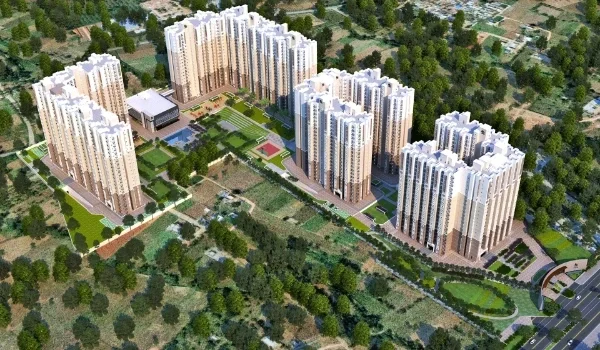
TVS Emerald Avalon is a new under-construction residential community spread across 12.44 acres on the 200 Feet Radial Road in Pallavaram, South Chennai. The high-rise project features 10 towers (2 Basements + Ground + 15 Floors) with 1,035 apartments and 80% open green areas. Home buyers can choose between 2 BHK homes (965 to 1,245 sq. ft.), 3 BHK homes (1,540 to 1,700 sq. ft.), and large 4 BHK duplex units (2,440 to 2,590 sq. ft.).
Base prices for 2 BHK flats at TVS Emerald Avalon start at ₹1.2 Crore onwards, with floor sizes starting well above the metro limit. Because every home here crosses both the ₹45 lakh price limit and the 60 sq. meter metro size rule, every apartment falls under the standard 5% GST slab without input tax credits.
| Cost Component | Calculation Basis | Outgo Amount |
|---|---|---|
| Base Agreement Value | Agreed sale consideration | ₹1,20,00,000 |
| Deemed Land Deduction | 1/3 statutory land abatement | ₹40,00,000 (Tax Free) |
| Taxable Building Value | 2/3 taxable construction portion | ₹80,00,000 |
| Applicable GST | 7.5% on taxable building portion | ₹6,00,000 (Effective 5%) |
| Tamil Nadu Stamp Duty | Indicative 7% of agreement value | ₹8,40,000 |
| Tamil Nadu Registration Fee | Indicative 2% of agreement value | ₹2,40,000 |
| Total Statutory Outgo | Taxes plus state registration fees | ₹16,80,000 |
Buyers at TVS Emerald Avalon pay this 5% GST in small parts whenever the builder sends a demand letter for a finished construction stage. Most banks do not add this tax amount to your home loan, so you need to keep your own savings ready to clear each tax payment.
4. Under-Construction vs. Ready-to-Move Units: Tax Comparison
A building's physical completion stage determines whether you must pay tax or get to skip it completely.
| Point of Comparison | Under-Construction Flat | Ready Flat (With CC/OC) | Resale Property |
|---|---|---|---|
| Applicable GST Rate | 1% (Budget) or 5% (Standard) | 0% (Fully Exempt) | 0% (Fully Exempt) |
| Input Tax Credit | Denied to Builder | Not Applicable | Not Applicable |
| Legal Status | Works Contract Service | Immovable Property | Immovable Property |
| Stamp Duty & Registration | Must Pay to State | Must Pay to State | Must Pay to State |
| Payment Schedule | Paid Stage-by-Stage | 100% on Handover | 100% on Handover |
If you buy a finished flat that already has an approved Occupancy Certificate, you save the full 5% GST out of pocket. However, builders often raise the base square-foot price on ready homes to make up for the tax they paid on steel and cement during construction.
5. Input Tax Credit Restrictions and Developer Price Impacts
Current tax rules do not allow builders to reduce their tax bill using the tax they paid on raw materials.
- Mandatory Supplier Rule: Builders must buy at least 80% of their construction supplies and services from registered tax-paying vendors. If they buy less than 80%, the builder must pay an extra 18% penalty tax under the Reverse Charge Mechanism.
- Cement Purchase Rules: Buying cement from unregistered dealers brings an automatic 28% tax penalty on the builder, no matter how much else they bought from registered shops.
- Cost Added to Flat Prices: Because builders cannot claim back the tax they spend on bricks, steel, and paint, they simply add these tax costs straight into the base price of the apartment.
FAQs
No, you cannot claim any tax credit as an individual flat buyer. The rule is simple: neither you nor the builder can claim input tax credit on new housing projects.
No, you do not pay any GST on resale flats. An old or second-hand flat is already a complete building, so it is fully exempt from GST under the law.
No, a flat with an Occupancy Certificate or Completion Certificate has zero GST. To get this benefit, you just need to book and pay for the home after the builder gets the certificate.
The builder must return your GST money along with your booking refund by giving you a credit note. If the time limit to issue a credit note has passed, you can apply for the refund directly on the GST portal as an unregistered buyer.
Flats at TVS Emerald Avalon cost over ₹1.2 Crore and have a floor area larger than 60 square meters. Because they cross both the price cap and the size limit, they do not qualify for the 1% budget slab and must pay 5% GST.